State of nature
Common SenseState of nature is Thomas Paine’s account of human life before government: people are naturally equal and free, and society arises first from mutual needs rather than political command. The imagined condition grounds a staged argument for political authority, which is necessary only when cooperation and virtue no longer suffice, and legitimate only insofar as it protects freedom and security.
Natural Liberty and the Formation of Society
Paine asks the reader to imagine a small group settling in an isolated part of the earth, unconnected with the rest of the world. In this state of natural liberty, society would be their first concern. A person’s strength is unequal to the range of human wants, while the mind is unsuited to perpetual solitude; each person therefore has reason to seek assistance from others, who in turn need help themselves. Society begins as reciprocal association, not as a command imposed by a ruler.
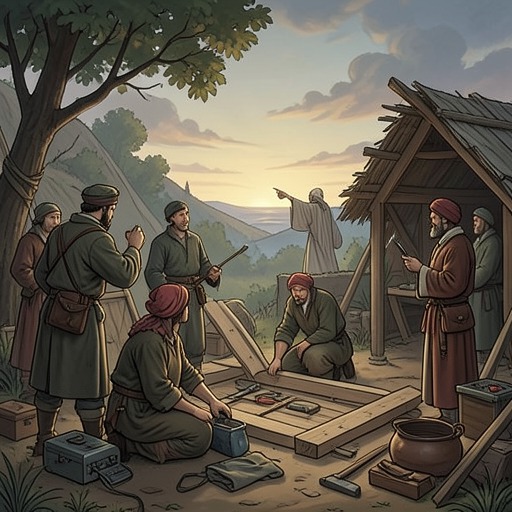
The practical force of this mutual dependence appears in Paine’s example of building a dwelling in the wilderness. Four or five people together could raise a tolerable house, whereas one person might work beyond the ordinary span of life without completing the task. After felling timber, an individual could neither move it nor erect it alone; hunger would interrupt the work, and competing needs would pull effort in different directions. Disease or misfortune could disable a solitary person so completely that survival itself became doubtful. Cooperation answers such vulnerabilities by joining capacities and distributing labor.
Paine describes necessity as a force that draws newly arrived emigrants into society. While they remain just toward one another, the reciprocal benefits of association can make law and government unnecessary. This distinction is central to the argument: society is not a product of government. Society answers human wants and encourages affection and intercourse; government answers the danger of vice by restraining it, creating distinctions, and punishing wrongdoing.
From Cooperation to Government
The imagined community does not remain permanently governed by spontaneous justice. As its members overcome the first hardships that bound them together in a common cause, they may relax their mutual duty and attachment. Paine treats this weakening of reciprocal obligation as the point at which government becomes necessary: political authority supplies what declining moral virtue no longer reliably provides.
The first public arrangements are deliberately simple. A convenient tree serves as a State-House, where the whole colony can gather to deliberate. Its earliest laws may be called regulations and enforced only by public disesteem. At this stage, every person has a natural right to a seat in the assembly. Political institutions thus emerge from the community’s own deliberation rather than preceding it.
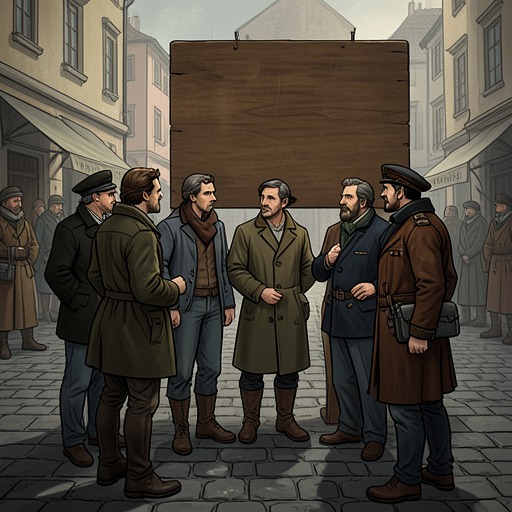
Growth makes direct assembly less workable. As the colony’s population, public business, and distances between homes increase, gathering everyone for every decision becomes inconvenient. The community can then consent to entrust legislative work to a selected number chosen from the whole body. As the colony grows further, it can be divided into convenient districts, each sending its proper number of representatives so that the interests of every part receive attention.
Paine links representative government to frequent elections. If elected representatives return after a few months to mix again with the general body of electors, they cannot easily establish an enduring interest separate from those who chose them. The prospect of returning to ordinary communal life gives them reason to remain faithful to the public. Frequent interchange, in this account, creates a common interest across the community; the strength of government and the governed’s happiness depend on that relationship, not on the title of a king.
Purpose and Limits of Political Authority
Paine calls government a mode made necessary by the inability of moral virtue to govern the world. Its design is freedom and security, and security is its true end. Since people cannot rely on conscience being clear, uniform, and irresistibly obeyed, they surrender part of their property to provide the means of protecting what remains. This is a prudential choice between evils, not evidence that government is naturally good.
Government is therefore a necessary evil even at its best and intolerable at its worst. Paine sharpens the cost of political failure by contrasting suffering under government with suffering in a condition without it: when people endure similar miseries while supplying the means by which they are harmed, their calamity is compounded by that knowledge. His image of government as the badge of lost innocence casts political authority as a response to moral failure; the palaces of kings, in the same passage, stand on the ruins of paradise. The metaphor marks a loss, not a natural entitlement to rule.
This account also sets a test for political form. The form most likely to ensure security at the least expense and with the greatest benefit is preferable to others. Paine accordingly values simplicity: a simple arrangement is less liable to disorder and easier to repair when disordered. His criticism of the English constitution follows from this standard, as does his objection to monarchy: political structures should be judged by their effects on freedom and security, not by inherited prestige or impressive names.
Equality and Republican Implications
Paine begins his discussion of political distinctions from the claim that humankind was originally equal in the order of creation. Differences between rich and poor can, he argues, be explained without treating oppression or avarice as their necessary origin. A more fundamental distinction is the division between kings and subjects, for which he finds no truly natural or religious justification. In this framework, political rank does not follow from the original equality of people; it is a later condition requiring scrutiny.
The natural community’s early right of participation anticipates Paine’s republican argument. His account of England identifies the elected House of Commons as the constitution’s republican part, while warning that crown influence can consume its power and virtue. When representation loses its independence, the promise of republican government gives way to subjection. The initial principle—that public authority must remain connected to the people who confer it—therefore becomes a standard for judging actual institutions.
Paine’s later proposals extend the same reasoning to continental government. He proposes annual assemblies with a president only, more equal representation, and domestic business subject to the authority of a Continental Congress. He also argues for a Continental Charter that would set out how representatives are chosen, define the jurisdictions of Congress and the assemblies, and secure freedom, property, and the free exercise of religion. These proposals turn the state-of-nature argument into a constitutional question: political power must be organized through public authorization and remain answerable to the purposes for which people establish it.
The argument also supports Paine’s rejection of delay and continued dependence on Britain. He describes repeated petitions as ineffectual and argues that the distant government cannot do justice to the continent’s needs. The appeal to natural rights and security thus reaches beyond the origins of government to the conditions under which political authority loses its claim to obedience. Independence, in this reasoning, is tied to the possibility of creating institutions that serve the people’s freedom and safety rather than frustrating them.